Wajda and War
The most frequently recurring theme throughout the great Polish director's career

In The Penguin Companion to the Arts in the Twentieth Century, Kenneth McLeish wrote that “Wajda’s great theme is war, and particularly the way in which the individual is simultaneously ennobled and degraded by the need for courageous action.” Having seen, I suspect, rather more of Wajda’s output than McLeish, including the films that didn’t secure wide international distribution, I’m not sure that I’d be quite that emphatic—but it’s certainly true that throughout his long career, from the very start with A Generation (Pokolenie, 1955) to its final decade with Katyń (2007), Wajda would regularly return to the subject of war in general and WWII in particular (i.e. the war that he experienced first-hand during his crucial formative years), as if it was an itch that he constantly needed to scratch.
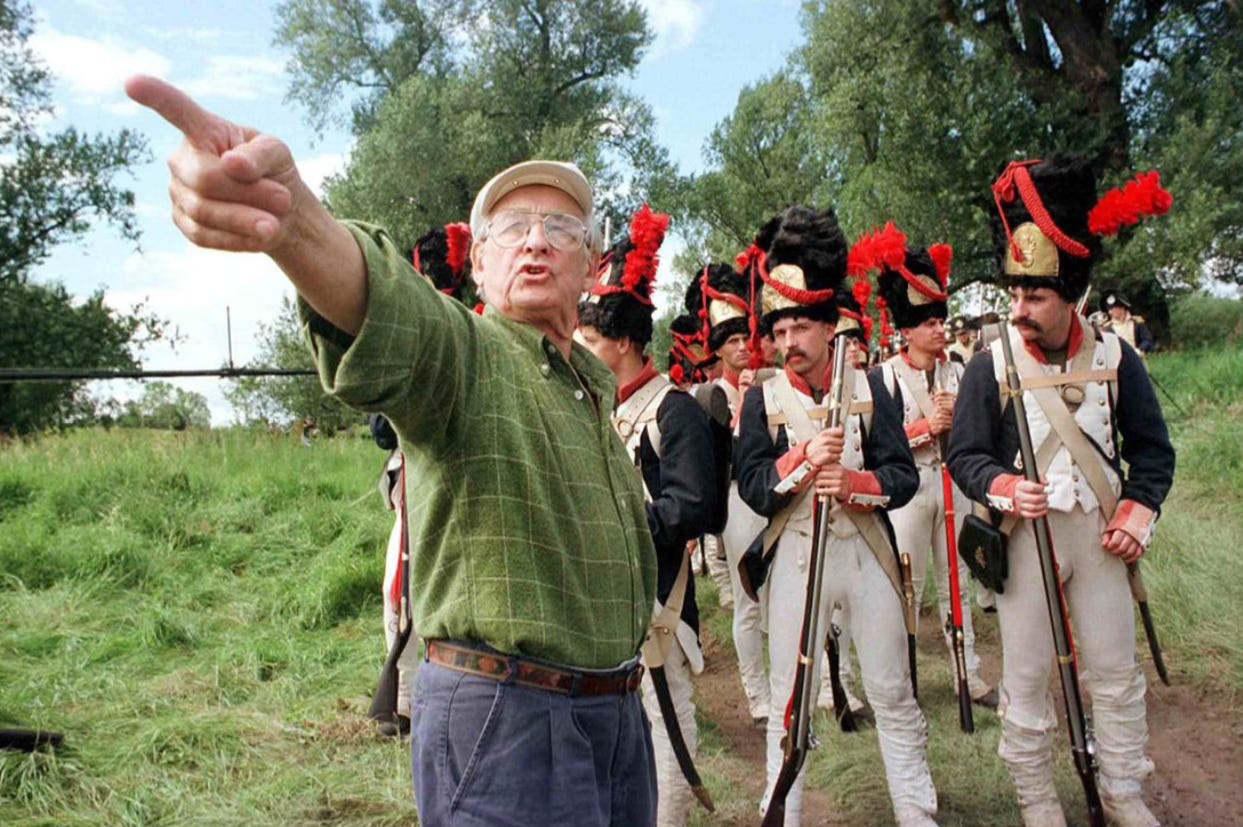
By way of example, five of his first six features are set during or immediately after WWII, and while things eased off after that, he also made Landscape After Battle (Krajobraz po bitwie, 1970), A Love in Germany (Eine Liebe in Deutschland, 1983), Korczak (1990), The Crowned-Eagle Ring (Pierścionek z orłem w koronie, 1992), Holy Week (Wielki tydzień, 1995) and of course Katyń (2007). He also addressed more distant historical wars involving Polish participants in The Ashes (Popioły, 1965) and Pan Tadeusz (1999), as well as anatomising revolutionary uprisings—one of which (Poland, 1980-1) he personally lived through and in which he played a key cultural role—in Man of Iron (Człowiek z żelaza, 1981), Danton (1982), and Wałęsa: Man of Hope (Wałesa. Człowiek z nadziej, 2013).
With the exception of the last two films, which dramatised the lives of the era’s main headline-grabbers (Danton also prominently features his historical sparring-partner Robespierre), Wajda’s focus throughout has been on the impact of war and revolution on the lives of ordinary people who just happened to be living in the wrong place at the wrong time—on his 13th birthday on 6th March 1939, Wajda would most likely not have had the faintest inkling of how the next few years would play out, with the Nazis invading within six months, the Soviets not long afterwards, the murder of his cavalry-officer father Jakub in early 1940, and his own often highly dangerous wartime activity as a teenage courier for the Polish Home Army as part of its anti-Nazi resistance network. And of course he witnessed first-hand the impact that this had on his mother—presumed widowed, but in the absence of any concrete information about what happened to her husband, there was always a flickering glimmer of hope.
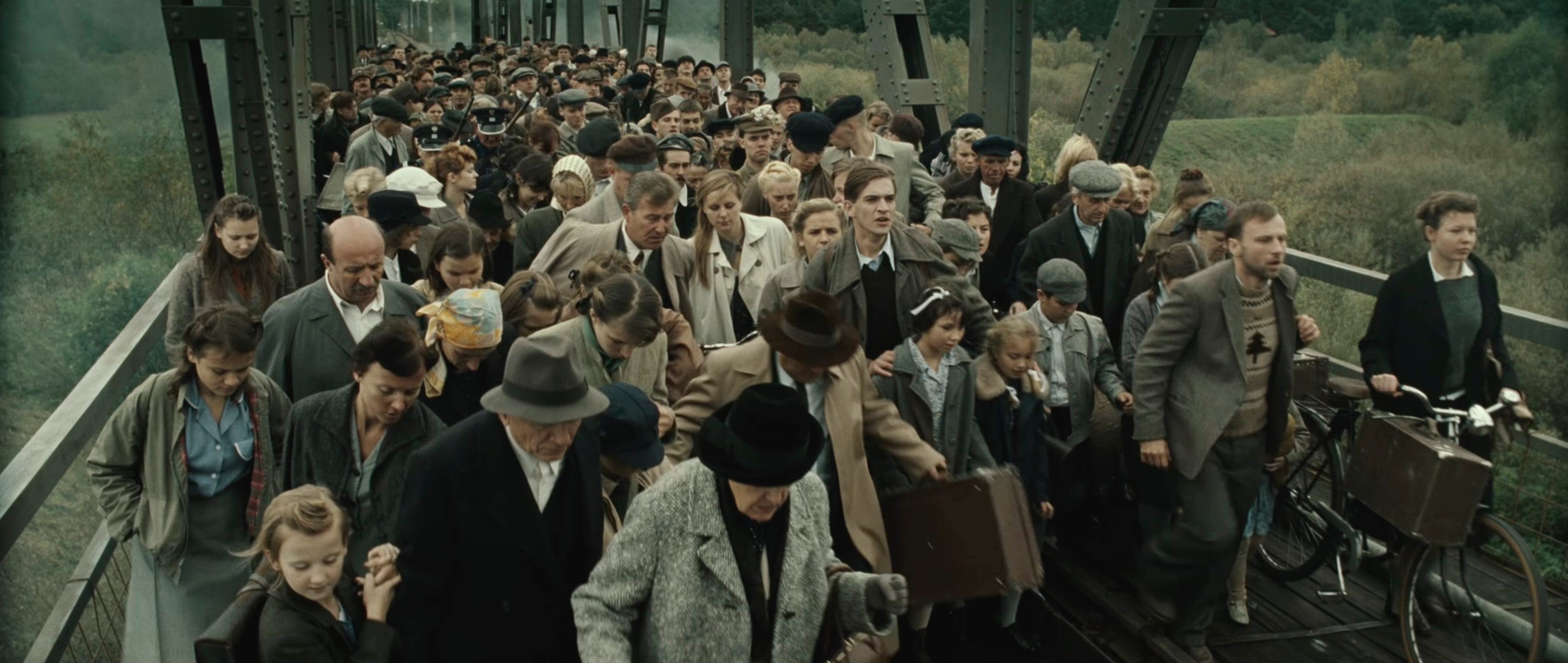
The opening of Katyń brilliantly dramatises the confusion felt by his fellow Poles about what was happening in September 1939, as crowds of people run into each other on a bridge; one group’s fleeing the Nazi invasion from the west, the other the Soviet invasion from the east. Soon afterwards, we’ll see the Polish flag torn in two in order to use it as a makeshift bandage; Wajda never could resist a potent bit of symbolism, even when his films were no longer subject to political censorship.
While most of the characters in Kanał are grizzled fighting veterans, Wajda makes a point of also including a mild-mannered musician (Vladek Sheybal) caught up in the confusion and who has to escape down the Warsaw sewers with everyone else. Similarly, the resistance fighters in A Generation started out as opportunistic tearaways, first seen robbing a goods train, while in one of the quieter moments in Ashes and Diamonds, the assassin Maciek Chelmicki (Zbigniew Cybulski) ruefully reflects on whether he’ll ever lead a normal life. Both he and his counterpart in Landscape After Battle, Tadeusz (Daniel Olbrychski) are trying to come to terms with the end of the war, while knowing that they can’t turn the clock back—even if Poland’s managed it, their own individual psyches can’t undo the atrocities that they’ve witnessed and indeed directly performed, albeit usually in extremis.
Another recurring theme is that of people ostensibly on the same side, but coming from markedly different backgrounds: The Ashes, for instance, is about three Poles (Daniel Olbrychski, Bogusław Kierc, Piotr Wysocki) whose differing social and military statuses symbolise the national and psychological confusion that followed Poland’s then-recent division into three protectorates run by Russia, Prussia, and the Austro-Hungarian Empire. They fight for Napoleon in the hope of regaining Poland’s independence (convincing themselves that he’s an ally, since he doesn’t share a nationality with any of Poland’s occupiers), only to find themselves backed into a corner, ordered to massacre Black rebels in Santo Domingo for having the temerity to assert their independence, while being fully aware of the irony and hypocrisy.
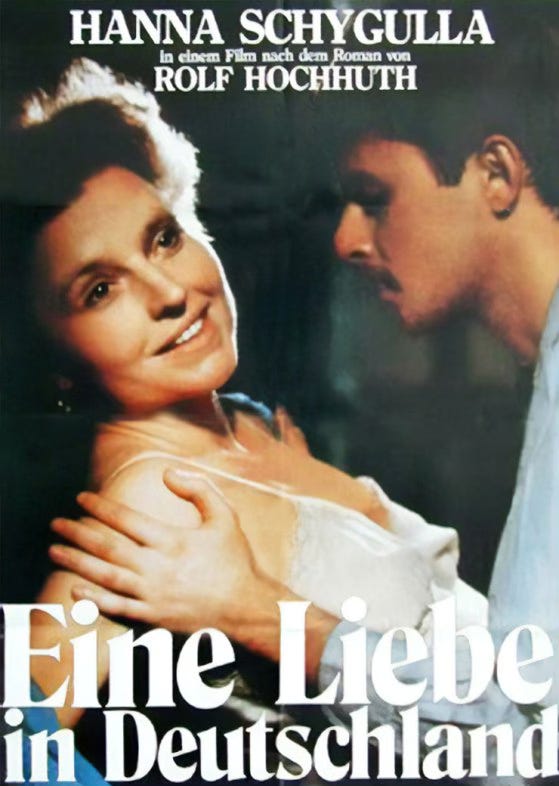
A lot of these films feature central romances, often fleeting, usually doomed, either because one or both of the characters involved don’t make it to the end of the film, or because there’s such a huge gulf between them based on their differing experience of the war that whatever brought them together in wartime won’t viably last into peacetime afterwards. A Love in Germany, as the title implies, is the film that’s most directly about this theme, but it’s told in flashback from the perspective of a man in 1983 delving into long-buried rumours that his German mother (Fassbinder regular Hanna Schygulla) had an adulterous affair with a young Polish POW (Piotr Łysak) during WWII, a time when sexual relationships between Germans and foreigners were strictly forbidden.
There’s a small but noteworthy subset of Wajda films that directly tackles the Jewish experience of WWII, starting with the minor supporting character of Abram (Zygmunt Hobot) in A Generation and then being developed in earnest in his sixth feature Samson (1961), continuing through Landscape After Battle, Korczakand Holy Week. The topic of Wajda’s Jewish-themed films will be the subject of a separate piece, as they also include the pre-WWII likes of The Wedding (1973), The Promised Land (Ziemia obiecana, 1975), and Pan Tadeusz (1999), but it’s worth noting here that of all major Polish filmmakers, and indeed most minor ones, Wajda has been the one who most consistently grasped the nettle of the subject of Polish-Jewish relations, and over a lengthy period, both in terms of his own output and the historical sweep he depicted. In fact, to quote him directly, he regarded this as “one of his major tasks”, albeit not one which, as we shall see, was necessarily always accomplished especially smoothly.