Talking about Wajda...
Recording commentaries for Second Run's War Trilogy Blu-ray box set

I still remember the first time I heard a DVD audio commentary by a critic as opposed to a direct participant in the film’s making; it was in mid-1999, and I’d just imported Criterion’s disc of The Seventh Seal, which included the veteran Ingmar Bergman expert Peter Cowie talking us through the film, flagging up historical and contextual detail in a way that I found absolutely enthralling—not least because he constantly referred to what was playing out onscreen in front of us.
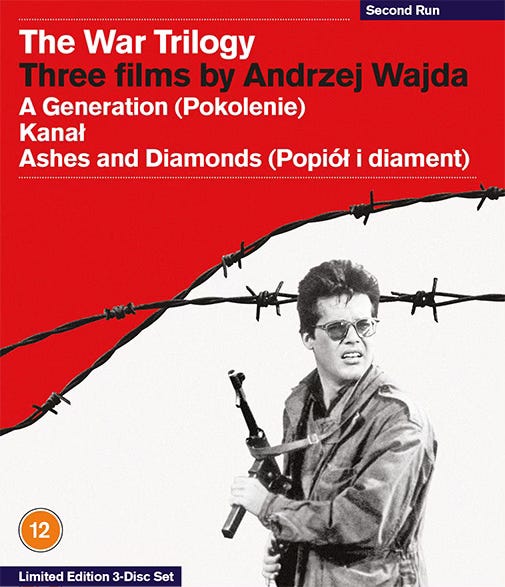
Back then, the idea that I’d one day be recording critical commentaries of my own didn’t factor into my wildest dreams, but over the past decade I’ve somehow managed to notch up nearly three dozen. And three of the ones of which I’m personally proudest were recorded for Second Run’s Blu-ray box set of the Andrzej Wajda War Trilogy in the autumn of 2022. While my record for a single film is Ingmar Bergman’s 135-minute Face to Face (for Imprint), at a combined 287 minutes the Wajda trilogy was easily my longest single commentary project to date.
That said, length certainly isn’t everything; two of my toughest commentary assignments on the “what the hell do I say next?” front were for Jan Němec’s Diamonds of the Night (a mere 68 minutes) and Jerzy Skolimowski’sWalkover (a similarly brief 74). By contrast, I had tons of raw material for the Wajda tracks, so my biggest challenge was deciding what should go where.
What rapidly became clear was that each commentary should consist of three intertwining elements: an analysis of what was happening onscreen, the real-life historical setting, and the circumstances of the film’s production a decade or so later, the latter two categories split up so that A Generation got WWII up to 1943 and Polish cinema up to 1955, Kanal got 1944 and 1956-57, while Ashes and Diamonds got the periods after that.
I tried to keep repetition across the commentaries to an absolute minimum, but also had to be mindful of the possibility that they wouldn’t be listened to in chronological order, or indeed that the discs might one day be sold separately. So certain topics like the taboo on mentioning the Polish Home Army were tackled in all three, albeit in vastly more detail in Kanal, where the topic was most relevant. Conversely, biographical details about co-star Tadeusz Janczar were minimised in the Kanal commentary, because I covered him extensively in A Generation.
So much for the theory, but how about the practice? As disc producer, QC inspector, editor, mixer, and critic reviewing someone else’s efforts, I’ve listened to several dozen, maybe even hundreds of other people’s commentaries over the last quarter-century or so, which has given me a very good idea of what I personally did and didn’t want. Although I appreciate that they’re probably much easier to put together, I’m not a big fan of commentaries that are essentially unsynchronised audio essays that just happen to be running alongside the film, and I’m all too familiar with the telltale signs of someone running out of material, as the gaps get noticeably bigger towards the end.
There are no training courses for this kind of thing (as far as I’m aware, anyway), so I’ve no idea if anyone else uses my methods, but I typically start by breaking the film (or films) down into a number of small chunks, each lasting about two or three minutes. I then devise something that can plausibly fill that section—or, if I’ve got too much material for one section but not enough for another, whether I can repurpose it. Sometimes this material will be scene-specific, sometimes it only requires a particular element to be present (for instance, talking about a particular actor when they’re actually onscreen), while at other times I’ll flag up parts where it’s perfectly obvious what’s going on in the film, and so I earmark those sections for things like talking about its inspiration, pre-production, or reception.
This part of the process is by far the most time-consuming, but it’s also essential; the more preparatory work I put in, the more satisfying the end result will be, certainly to me, and hopefully to the listener as well. Even when I record commentaries in a much more “live” situation with my regular commentary partner Johnny Mains, we individually do a ton of prep in advance and then sit down to watch the film together the day before the actual recording, agreeing in advance what’s going to go where and who’s going to cover what.
The final preparatory stage involves creating a video file of the film with burned-in subtitles (since it has to play in silence), which I load up into Final Cut Pro X, using its “Record Voiceover” function to record the commentary itself straight into the timeline. The great advantage of this method is that I don’t have to be absolutely precise in terms of timing when recording, as that can be tweaked later—and if I specifically want to be in sync with something, I can insert a little marker that will alert me as to how quickly that moment is approaching. (Another bugbear of mine is with commentaries that say “OK, in this bit… no, not quite yet… I’m sure it’s any minute now… oh, there it is!”)
Here’s a concrete example from Kanal (whose thumbnail features the future From Russia With Love supporting villain Vladek Sheybal on the left):
For this section, there were six pre-planned sync points, or roughly one every thirty seconds.
00:04—”this cross” is said when the cross is actually visible on screen;
00:15—the two actors are now in position so I can briefly introduce them (Wieńczysław Gliński gets a more elaborate bio later on, as he had a very interesting post-Kanal career as well);
01:05—as the name “Bartek” is uttered, I mention that it was also a codename used by a major character in A Generation;
01:18—as “the 56th day” is brought up, I discuss the likely real-life date in which these scenes take place, and contextualise it;
01:40—”or indeed womanpower” is timed to accompany the cut to the female resistance fighter;
02:09—for obvious reasons, my “whoa!” reaction to the revelation of the extent of her injuries was precisely timed to the frame.
And in terms of content, there’s a general mixture of production information (three actors are identified by name, with a bit of trivia about two of them), WWII context (the date these scenes are taking place, the role of women as combatants), and reception information (how the film fared with the British Board of Film Censors on its initial UK release).
A key part of A Generation presented a different timing challenge, in that it didn’t matter too much when I started a particular section, but it was very important that I ended in perfect sync with Tadeusz Janczar getting shot, as this is believed to be the first instance of an explosive squib used to simulate a real-time bullet wound in a film, a decade before Sam Peckinpah’s eruptive gorefests. Fortunately, this was very easy to facilitate in FCPX, as I could just tweak the relevant audio clip so that it ended on time.
Every commentary presents a fresh challenge, depending on the individual film, its length, content, pacing, rhythm, or any number of other factors. I may have very little pre-existing material to draw upon and have to fall back on my own analytical skills, or I may have loads, but am then faced with the challenge of working out where best to put it. I also try to imagine what kind of person will be listening to it, what they might plausibly want to get out of it, and what they’re likely to know already.
For instance, I assume that someone buying an Andrzej Wajda film on a UK label is going to have at least a basic grounding in film history, but not necessarily much expertise in specifically Polish film history, still a pretty niche area in English-speaking circles. If I was specifically targeting a Polish audience, I’d do quite a few things differently, and might well hesitate before taking on the job at all! And while this doesn’t apply to my Wajda commentaries, when I recorded a commentary for Paolo & Vittorio Taviani’s Allonsanfàn (for Radiance), I said “Obviously that’s Marcello Mastroianni on the right, one of the most instantly recognisable faces in European cinema even under a scraggly beard, and I don’t propose to insult your intelligence by rattling off a biography that you’re almost certainly familiar with already”, which freed up space for talking about less renowned participants.
Which reminds me: the two things that people seem to complain about most vociferously with regard to commentaries are (a) “IMDB-padding”, or merely reciting someone’s filmography as a blatant space-filler, and (b) simply describing what’s already perfectly obvious. With regard to the first of these, most of my commentaries are for central-eastern European films where there’d be absolutely no point reeling off a filmography, as most of the titles will be totally unknown in English-speaking countries and many won’t even have official English titles.
On the other hand, because the actors are often equally little-known, I try to find something brief but memorable by way of characterising them—in the Kanal clip, I mentioned that one of the actors lived to 103, making him the oldest Polish actor at the time of recording, and in The Round-Up (Kino Lorber), I mentioned that an actor was sentenced to death for his involvement in the 1956 Hungarian revolution, although thankfully it was commuted to a prison term, and he was freed in time to make the film. And when I found out that the older of the two boys in Diamonds of the Night later defected to the US, where he worked as a photographer for Frank Zappa before becoming the art director of Hustler magazine, in which capacity he was able to provide his compatriot Miloš Forman with essential behind-the-scenes info when Forman was making The People vs. Larry Flynt, I mentally punched the air; stuff like that is commentary gold.
As for describing what’s already perfectly obvious, that can be something of a balancing act if you’re fond of very scene-specific commentaries (as I am), and I find that I often have to honestly ask myself whether I’ve fallen into that trap or whether I’m genuinely adding stuff that isn’t clear merely from watching the film. I’m sure I’ve slipped up on occasion, but hopefully my treatment of one of the most famous parts of Ashes and Diamonds is an illustration of how to do it properly—I refer to what’s on screen often enough to maintain the impression that I’m watching the film with you, but I hope that that I’m genuinely exploring what’s happening rather than merely verbalising it.
These remain my only three Andrzej Wajda commentaries to date; he ties with his former protégé Jerzy Skolimowski (Walkover, Barrier, The Lightship) for the most that I’ve done for a single filmmaker. Although this is probably an opportune moment to confess that I chickened out of doing Man of Marble for Second Run back in 2014. These days, I’d say yes like a shot, but I hadn’t recorded a commentary back then, and while I was reasonably happy with how the first fifteen minutes went, I got cold feet about being able to fill more than two-and-a-half hours, a pretty tall order for a commentary debut. My research wasn’t wasted, though, as it found its way into the lengthy booklet essay.
But since I still have my original commentary notes, I thought I’d sign off this piece by treating you (if that’s the word) to how Man of Marble might have opened if I’d gone ahead: